English
 Arabic
 Chinese (Simplified)
 French
 German
 Spanish
 Vietnamese
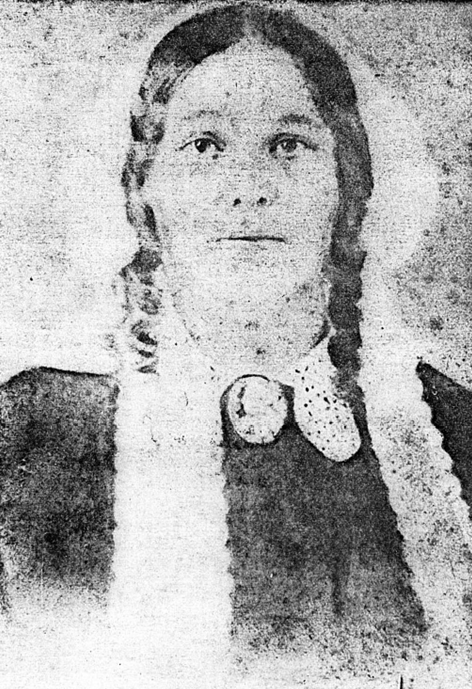
This year America celebrates 250 years since its founding, and communities across the nation are taking time to reflect on history from that era. Transylvania County is proud to highlight five North Carolina patriots for local celebration this year. This is part of a series of Patriot Profiles.
Sallie Salter, Mother of Many
Sarah Lloyd was born on November 27, 1742 in Bladen County, NC to parents John Lloyd and Sidney Paul. Like many families in the American colonies, her parents were from England and settled in the Americas, slowly migrating inland from one location to another over the years. It seems likely the Lloyd family was in New Jersey and then Virginia for a time before coming to North Carolina.
Sarah Lloyd who went by “Sallie” married William Salter Jr. on May 31, 1764; they started a family the next year beginning with their son Richard in 1765, followed in years to come by Mary, Elizabeth, Sarah, Ann, William III, James, and littlest Margaret born in 1783. This made Sallie, a mother to eight children, involved in childbearing over the span of almost twenty years.
Revolutionary Center
During the American Revolution, Sallie’s husband William was a civic leader at the heart of the resistance. Over the many years of conflict, colonists were taken by Loyalists and imprisoned, livestock and provisions were confiscated, and some amount of terror was inflicted upon the residents of Elizabethtown on the Cape Fear River.
Patriots from surrounding areas who’d been driven from their homes by British forces gathered at William Salter’s property at Little Sugar Loaf for refuge and to strategize. Located near King’s Bluff on the east side of the Cape Fear River, Salter’s property was uniquely distant but connected to Elizabethtown, making the revolutionary activities occurring there less visible to occupying British troops, but close enough to monitor British activities.
The Patriots, or “Whigs,” realized that they were outnumbered by British troops, but not by how much. Led by Col. Thomas Brown and Col. Thomas Robeson, the Patriots floundered not knowing what exactly they were up against but feeling that the odds were not in their favor.
Spy Intelligence
Intelligence about the British encampment was vital, but what man could possibly pass undetected into enemy territory, when all men were suspected of being soldiers and often conscripted into service or imprisoned? The only one who could go unnoticed, it was decided, was a woman. Sallie Salter, the wife of their host, volunteered. It should be noted that at this time, she was a 39-year-old mother of seven with the youngest less than one year old.
A plan was devised in which Sallie took a basket full of eggs and socks across the river to the British encampment to sell them to the soldiers. During this violent time, regulation was meant to keep colonists safe, so crossing the river was not permitted. Somehow Sallie convinced the ferryman to let her catch a ride on one of the British supply rafts, and she was allowed to cross to the enemy encampment.
While in the enemy encampment, she was permitted to move about the camp to sell eggs and socks to the British soldiers. Unbeknownst to them, Sallie took mental notes of the number of men, the type of equipment, and the leadership present as she humbly sold necessities to the battle-worn troops.
Sallie Salter reported back to the Patriot leadership that there were about 300 soldiers, with Col. John Slingsby and David Godden in charge. The Patriots had 70 on their side and knew that a head-on fight would not be their best chance. Strategizing continued, and at last a plan was formulated and enacted – quickly—before the intel changed.
The Battle of Elizabethtown
The British were camped on the other side of the Cape Fear River and were keeping all boats under their control. How would the Patriots attack? Under the cover of darkness on August 27, 1781, the Patriot group rode their horses as close as they could to the British encampment and tethered them there. The Patriots stripped down and carried their clothing and rifles above their heads as they forded the river, arriving on the other side to re-don their apparel and attack the sleeping British in the night.
The men divided into three groups, all attacking from the cover of woods, shouting commands to men who did not exist to give the illusion of a much bigger force. They used the name “Washington” to imply they were being led by the famed general to further the intimidation.
The Tory leader was found first and killed along with the other officers of the encampment, leaving the British with no commanders. The petty soldiers had no idea what to do and panicked. Many of them fled to a ravine, which unfortunately for them had no outlet. Seventeen Tories were cornered and killed; the others fled. The location is still known as “Tory Hole” today.
The Patriots had no casualties and four wounded. Their attack complete, they then forded back across the river, took to their horses, and rode away. This victory was final proof to the British that rural North Carolina would not be easily won. The British force diminished in North Carolina significantly after the Battle of Elizabethtown.
Remembering Sallie Salter
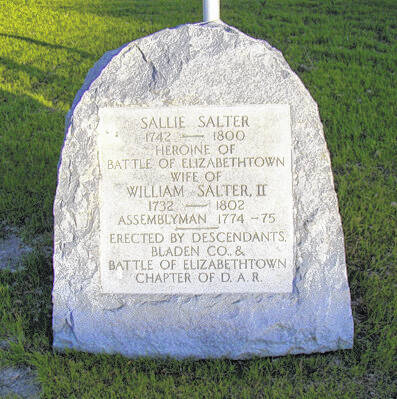
Sarah Lloyd Salter died on December 23, 1800 at age 58. Her actions leading up to the Battle of Elizabethtown led to a decisive victory by the Patriots and is remembered by descendants today. A Daughters of the American Revolution chapter is named for the Battle of Elizabethtown, and both the Lloyd and Salter names live on.
Photos and information for this column are provided by the Rowell Bosse North Carolina Room, Transylvania County Library. This article was written by Laura Sperry, Local History Librarian. Sources available upon request.