English
 Arabic
 Chinese (Simplified)
 French
 German
 Spanish
 Vietnamese
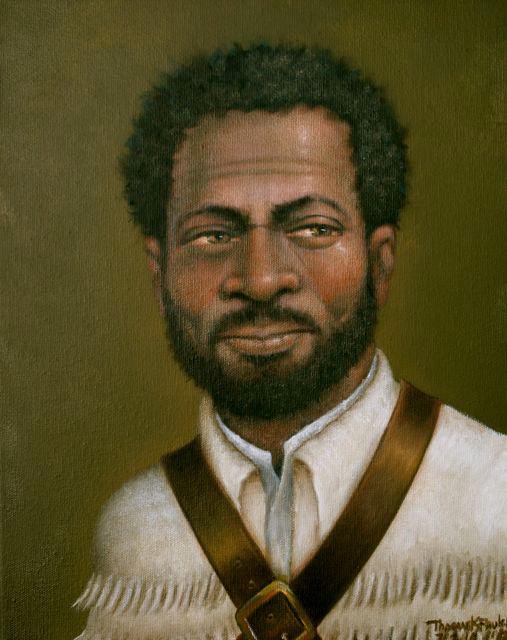
This year America celebrates 250 years since its founding, and communities across the nation are taking time to reflect on history from that era. Transylvania County is proud to highlight five North Carolina patriots for local celebration this year. This is part of a series of Patriot Profiles.
Born into Slavery on the Cusp of Revolution
The details of Ishmael Titus’ early life are unclear. Like many enslaved people his exact origins, birth date, and personal history are shrouded in the invisibility of his social class in hierarchy. There are differing accounts of his biographical details and life experiences, and many discrepancies that have not been reconciled.
It seems likely that Ishmael was born into slavery in Lunenburg, Virginia anywhere from 1743-1746. His ancestral origins were of the Fulani people of West Africa – a semi-nomadic herding culture.
Ishmael would have been enslaved at the beginning of the American Revolution. The American colonists were unsure about how they wanted to approach the enlistment of the enslaved and freed black men. Although the slavery status he was cast into meant that his birthdate was never recorded, his enlistment wouldn’t have gone through typical channels. It’s possible that he was one of many soldiers who fought through the Revolutionary War without recognition.
Life Beyond War and Enslavement
Ishmael first shows up on Census and church records in 1812 with his marriage to Lucy Rogers. Details are difficult to confirm for Ishamel Titus’ personal life. It’s been accepted that he married Lucy Rogers of Savoy, Massachusetts on September 20, 1812 when he was 69 and she was 26 years old. It is murky how many children they had. It seems certain that there were at least twelve boys and one girl, born from 1810 to 1845.
It isn’t certain if Lucy was mother to all of the children, or if Ishmael may have had a prior marriage. The Titus children that researchers agree upon are Harvey, Lucy, Levi, Ned, Walter, Pike, Thomas, James, Henry, William, Jerry, Alfred, and Glasco. Modern-day Titus descendants specify which child’s line they descend from to distinguish their research and connect more closely with near relatives.
It is possible more girls were also part of the family but that their names were lost to marriage and time. Ishmael was elderly and not expected to work by the time Census records were taken, so we have no record of what his employment outside of military service was during his life. The children belonging to him are also difficult to determine because Federal Census records did not include individual names until 1850, well past the time when Ishmael’s children would have been living at home.
Difficulties in Life
On November 27, 1816 Ishmael Titus was summoned before the elected officials of Pownal, Bennington County, VT and ordered to leave town and never come back, ceasing any and all enterprise there. It does not mention what offense caused them to take this action, but it should be noted that the same official document book includes many similar legal actions for other townspeople.
In these records, Ishamel is described as “black” but no one else who is being evicted is, so it cannot be assumed that the request to leave was for racial reasons. Despite this mandate, Ishmael and his family are still listed on the 1820 Census as living in Bennington County, VT, so perhaps they were permitted to be a small part of the community but not at its center or privy to all of its privileges.
Ishmael and his family then moved to the Williamston, MA area. One source indicates that he lived in the “colored” part of Williamstown in an area known as White Oaks north of Broad Brook. The same source mentions that he had a large “wen” on his neck, which was likely a goiter due to a lack of iodine, and that his son Harvey Titus lived nearby.
The 1832 Version of Ishmael’s Military Service
For all intents and purposes, Ishmael seems to have lived his life simply and without much indication of military service until 1832. When Andrew Jackson became president, he piloted several initiatives to bolster military recruitment. One such action allowed men to earn a pension from military service – and to prove good on this benefit, the Federal Government offered pensions for proven past military service as well.
Ishmael Titus was 89 years old when he applied for a Revolutionary War pension. If he hadn’t applied, we would know much less about him, his family, and his military involvement.
According to an affidavit filed by Ishamel in 1832, his first enslaver was Harry Bluford, a Dutch immigrant in Amelia County, Virginia. At about age 13 Ishmael was sold to John and Richard Muir, two Scottish immigrant brothers who lived in Dan River, NC just over the Virginia-North Carolina state line. He was not sure how long he lived with the Muir brothers and then was sold to planter Lawrence Ross in Rowan County, NC.
When the American Revolution began, Ishmael is said to have fought in the place of Lawrence Ross in exchange for his personal liberty. After one year of service, he was granted freedom by Ross, and then chose to enlist as a freeman, serving for two more years.
All of this information came from the 1832 affidavit, in which Ishmael attempted to apply for a military pension based on his service in the Revolutionary War. He mentions the major battles that he claimed to be involved in, for which the court official added specific dates: the Battle of Camden on August 15, 1780; the Battle of King’s Mountain on October 7, 1780; the Battle of Guildford Courthouse on March 15, 1781; and the battle at Deep River July 29, 1781. He did not remember these dates on his own but conducted advance historical research to find dates, names of battles, and revolutionary leaders in order to file his claim.
Ishmael claimed to have been in the service of Lawrence Ross for one year starting in 1779 before any true battle began, during minor skirmishes among the “Tories and Indians.” He then served of his own accord for two additional years 1780-1781, when his service discharge occurred near the Holston River at a “log courthouse”.
The affidavit states that after being discharged from military service in North Carolina, he moved to New Rochelle, NY; Ballston, NY; Troy, NY; Pownal, VT; and Williamstown, MA where he spent the remainder of his life. Although it may seem as though he lived in a wide variety of places, maps indicate that the area where Ishmael lived was at the juncture of New York, Vermont, and Massachusetts state lines, so all of the smaller hamlets were in close regional proximity to one another.
This pension application was denied. Ishmael couldn’t prove his birth or service, and the courts didn’t see evidence of the existence of the military captain he claimed to serve under.
The 1855 Version of Ishmael’s Military Service
Another story that was published after Ishmael’s death in a Vermont newspaper recounted a different version of events for his military involvement. In this 1855 version, Ishamel Titus did not actively fight in the Revolution. In 1755 he was about nine or ten years old when his enslaver was employed by the commissary to transport supplies to soldiers in combat who were part of the Patriot General Braddock’s ill-fated campaign during the French and Indian War.
The quantity of supplies that was required meant adding a third horse to the party, and young Ishmael was asked to be a wagoner. Young Ishmael is said to have seen so many British red coats that he thought their clothing must be soaked in blood.
In this version, Ishmael escaped his unnamed enslaver and settled in New England at the age of 38-40, which would have been some time just after the Revolution from 1783-1786. It doesn’t mention any military service, emancipation agreement, or the like. This version is very different than the 1832 affidavit. Both versions were recorded decades after the Revolution.
Questions About Enlistment for Freedom
The National Park Service is a respected repository of historical information and has studied this question: were those who were enslaved during their enlistment emancipated because of their military service in the Revolutionary War? The NPS findings describe the inconsistent way that Northerners viewed slavery, hierarchy, and status when it came to military service-based emancipation.
Although all soldiers were needed, recruiting officers turned away men of color in the earliest days of revolution, worried about what they might learn while training for combat. Some state mandates allowed people of color to serve in militias but not to be trained with weapons. The fear was that if they were taught how to use weapons, they would use them against their enslavers.
At no time did any state or federal government offer freedom to the enslaved in exchange for revolutionary military service; any negotiations for emancipation in exchange for service would have been personal contracts between the enslaved and enslaver. At this point in history, there was no push to recognize the enslaved as autonomous people. The enslaver was seen as a legal person with rights to property, not the enslaved. Sign-on bonuses and compensation could have been commandeered by the enslaver even when earned by the enslaved. Emancipation bargains were sometimes struck only to have the enslaver renege on their commitment after the enslaved’s military service had been completed. The enslaved had no legal recourse for this.
Freedom Fighter or Freedom Finder?
Ishmael’s 1832 pension application was denied. His identity and service record were unrecorded. We may never know the true version of events and the extent of Ishmael’s service in the American Revolution. Could it have happened, or was the story more fiction than fact? Either way, the chaos of the Revolutionary War provided an opportunity for Ishmael to find freedom and liberty at any cost.
Ishmael Titus passed away on Jan. 27, 1855. His burial location is unknown, but many descendants and historians honor his life today and the legacy left behind by him and the many enslaved black soldiers who fought in the American Revolution. He and others are recognized on the “Liberty Walk” historical trail in Charlotte, NC.
Photos and information for this column are provided by the Rowell Bosse North Carolina Room, Transylvania County Library. This article was written by Laura Sperry, Local History Librarian. Sources available upon request.