English
 Arabic
 Chinese (Simplified)
 French
 German
 Spanish
 Vietnamese
This year America celebrates 250 years since its founding, and communities across the nation are taking time to reflect on history from that era. Transylvania County is proud to highlight five North Carolina patriots for local celebration this year. This is part of a series of Patriot Profiles.
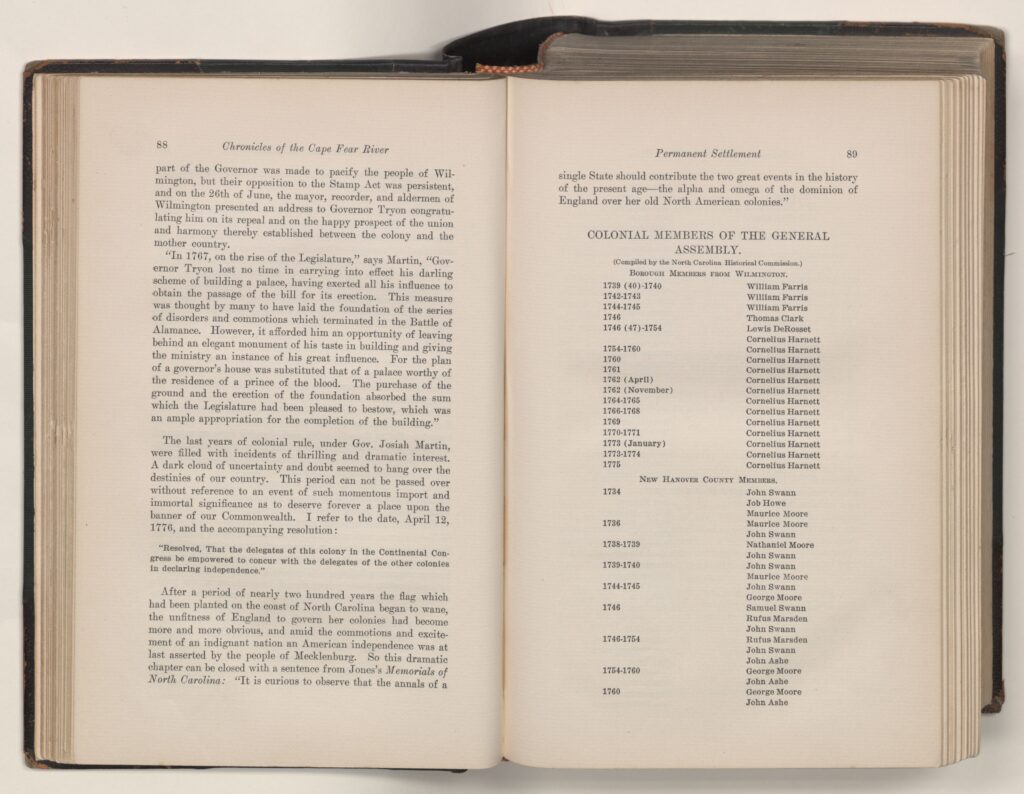
The story of Cornelius Harnett Jr. (1723-1781) continues. Harnett was politically active in the early formation of the colony’s governing laws, and it is said that he was involved in the drafting of the Mecklenburg Declaration of Independence.
The Question of The Mecklenburg Declaration of Independence
The Mecklenburg Resolves were published in a regional NC newspaper on May 20, 1775, which leads to a controversial piece of history. North Carolina has long claimed to be “first in freedom” with their assertion of the Mecklenburg Declaration of Independence being drafted on May 31, 1775. Historians question whether the so-called Mecklenburg Declaration of Independence ever actually happened. Evidence has led them to believe the story to be a false history created from the misinterpretation of the publication of the Resolves.
The authenticity of the nicknamed “Meck Dec” was first called into question by Thomas Jefferson in 1819, when it was first published. After Jefferson’s death in 1838, his letters were published and 1819 correspondence between him and John Adams revealed that Jefferson believed the Meck Dec to be a hoax. A committee was created to gather information about the alleged document which found many discrepancies.
John McKnitt Alexander published the Meck Dec for the first time in a Raleigh newspaper in April 1819, claiming that his elderly father had attended the meeting in his younger days and had recounted the occurrence and text of the document to his son via dictation several years later. Oddly the “event” had never before been documented until 1819, despite many years passing since the end of the revolution. It was also suspicious that allegedly the original document had been destroyed in a fire and was therefore unavailable to verify.
The elderly Mr. Alexander’s recollection could have been faulty, but there is another potential reason for the miscalculation: the shift from the Julian calendar to the Gregorian. The rural colonies changed their calendar system in September 1752. In order to calibrate to the new system, September 2, 1752 was followed by September 14, 1752, leading to a loss of 11 days.
This shift means that when some claimed that the Meck Dec had been written on May 20, 1775, and the Mecklenburg Resolves published on May 31, 1775, they may have been referring to the same event, which was the publication of the Resolves and not a “Declaration”.
Since the “signers” were not known, a group compiled a list of men who they believed would have signed the document, based on the memories of the few remaining elderly men who had claimed to be there when the national Declaration had been read aloud and their official positions held at the time of the alleged signing. The testimonies of the men did not agree in detail. Additionally, even if some sort of document existed, none of them remembered an in-person signing event.
Descendants began conducting their due diligence to prove the document’s authenticity but found more evidence to prove it was a fabrication. In 1838 archivist Peter Force found a June 1775 re-publication of the Mecklenburg Resolves in a South Carolina newspaper which did not match the Meck Dec wording, more closely resembled the accepted version of the Resolves, and fell short of declaring independence. It did, however, match other local resolutions of the time.
Many an ancestor had been given the honor of having been a signer of the Meck Dec by their descendants, and the emotional connection people felt to the history they believed to be true could not be ignored. Perhaps this emotional attachment is why, despite evidence to the contrary and very little evidence thereof, some could not accept that the document was a hoax. Most contemporary historians agree that there never was a Meck Dec. Just the same, Charlotte still celebrates “Meck Dec Day” every year and reads the fabricated document aloud with celebration.
Whether or not the debatable Meck Dec was one of Harnett’s actions, it does seem verifiable that when the NC colonists got the news that the country-wide Declaration of Independence had been written, it was read aloud by Cornelius Harnett Jr. on July 27, 1776 at the Halifax Courthouse. He was then the Provincial Congress President for NC. He continued to serve as a delegate to the Continental Congress from 1777-1781 at his death.
The End for Cornelius Harnett Jr.
Cornelius Harnett died in 1781 as a result of a concentrated strike on the revolutionists in the Cape Fear region of NC led by Major James Craig under the direction of Lord Cornwallis of England. Cornelius Harnett was identified as a leader and threat by the British and targeted for attack. He was forced to flee his home and managed to make it to a friend’s home in Onslow County before the British caught up with him. Harnett was troubled by gout, however, and was caught and treated very roughly. He was bound and forced to walk as far as he could before he collapsed and was then draped over horseback “like a sack of meal” and imprisoned in an open blockade. Exposed to terrible conditions, his health rapidly deteriorated; although he was released, his health never recovered after his captivity, and he died on April 20, 1781.
Sometime during his colorful life he had married Mary Holt, daughter of Martin Holt, and they lived at Maynard, now known as Hilton. They also had a second plantation, Poplar Grove, that is present-day Scots Hill on Topsail Sound. They don’t appear to have had any children. Mary died in 1792 in New York and was buried next to her husband Cornelius in St. James Churyard Cemetery in Wilmington.
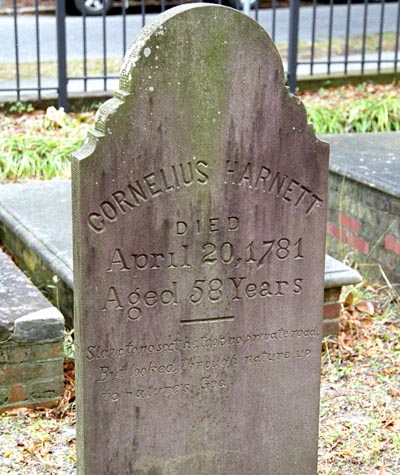
The cemetery is associated with an Episcopal congregation, but Harnett did not profess to be of that faith. He was known to be a Deist, similar in belief to Benjamin Franklin and Thomas Jefferson. For those unfamiliar with Deism, it’s based on the concept of a “clockmaker” God who created and set things in motion, but who is now uninvolved with humanity. The same school of thought believed that there were no miracles and that prophesy and divinely inspired revelation were suspect. So firmly did Harnett adhere to his beliefs that his grave marker bears the inscription: “Slave to no sect, he took no private road. But looked through nature up to nature’s God.” That same independent spirit led him throughout his life and helped to spark a revolution.
Photos and information for this column are provided by the Rowell Bosse North Carolina Room, Transylvania County Library. This article was written by Laura Sperry, Local History Librarian. Sources available upon request.