English
 Arabic
 Chinese (Simplified)
 French
 German
 Spanish
 Vietnamese

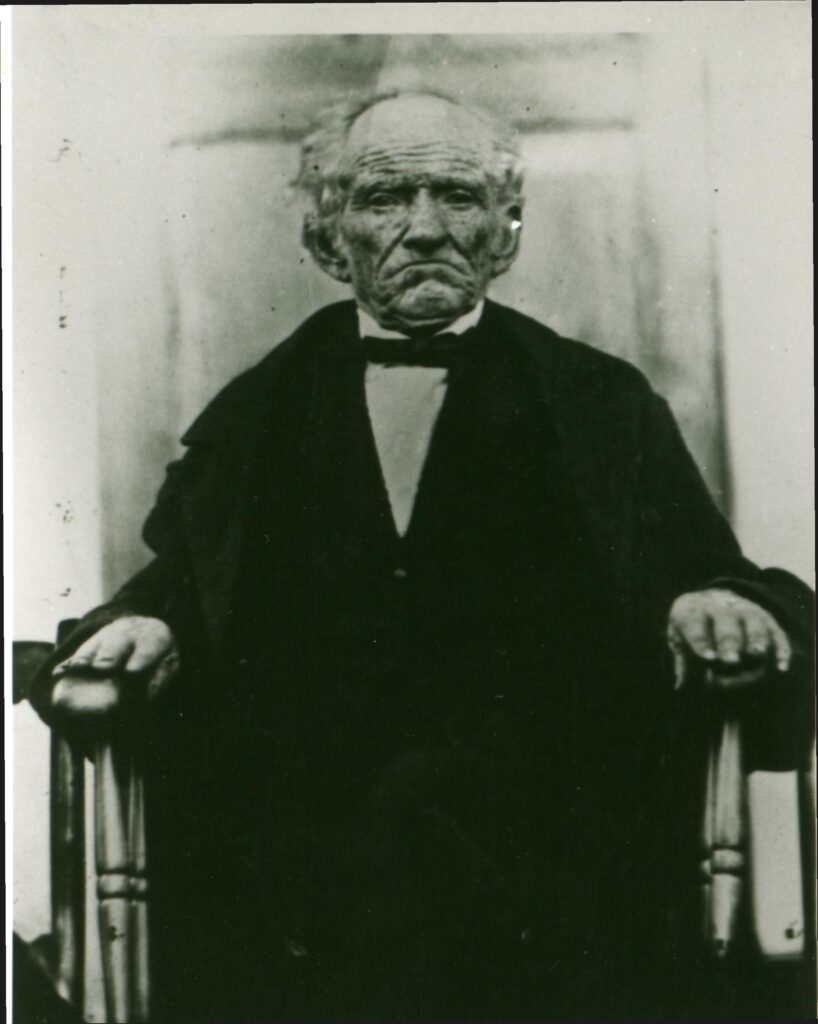
Within the Pisgah National Forest of Transylvania County, one rustic cabin remains in its original location: the Hiram King House. The property was owned by an early settler of the region, Hiram King (1794-1891) who is recorded as being born in what is now Transylvania County on Christmas Day 1794, though some sources cite 1792. Hiram was the eldest son of twelve to parents Joseph James King (1770-1849) and Leodicia Morgan Parks King (1772-1849).
The King family started out in Rutherford County, NC and moved to north Georgia, then to Buncombe County, NC, and finally to what was then Henderson County, NC near the French Broad River. Like many other families, the Kings owned land in the “Pink Beds.” This area was settled extensively and had a post office, church, school, and hundreds of family properties prior to the creation of the Pisgah National Forest.
King land was developed with mills and mines to draw wealth from the earth. In addition to owning and managing extensive acreage in the Pink Beds, Hiram was a businessman and civic figure. He was an early trustee for the creation of a community school and later was a trustee for the land that would be the site of the community church, utilized by many different congregations in those early days of European settlement.
Deeds and property ownership were a bit unclear in the early organizing days of western North Carolina. Handshake deals and informal land inheritance left some property owners vulnerable to Vanderbilt’s desire to acquire as much land as possible in the woodlands and mountains of western NC. Documents in the NC Room at the Transylvania County Library show that Hiram King’s descendant Hiram Woodfin King had to defend his long-term ownership in a legal dispute with Vanderbilt and succeeded in retaining the family property known as “Rich Bend.”
When the Kings eventually did sell the land in Pisgah National Forest, only their cabin remained. This cabin and many others abandoned by settlers once their land was sold to Vanderbilt were taken over by the at-times unruly Biltmore Forestry School students in the 1900s, who renamed the houses with silly and exaggerated names such as “Little Hell-Hole” and “The Palace.” Such a stark contrast to how the early settlers would have viewed their mountain paradise of self-sufficient systems and living off the land.
In addition to owning and managing extensive acreage in the Pink Beds, Hiram was a businessman and civic figure. He was an early trustee for the creation of a community school and later was a trustee for the land that would be the site of the community church, utilized by many different congregations in those early days of European settlement.
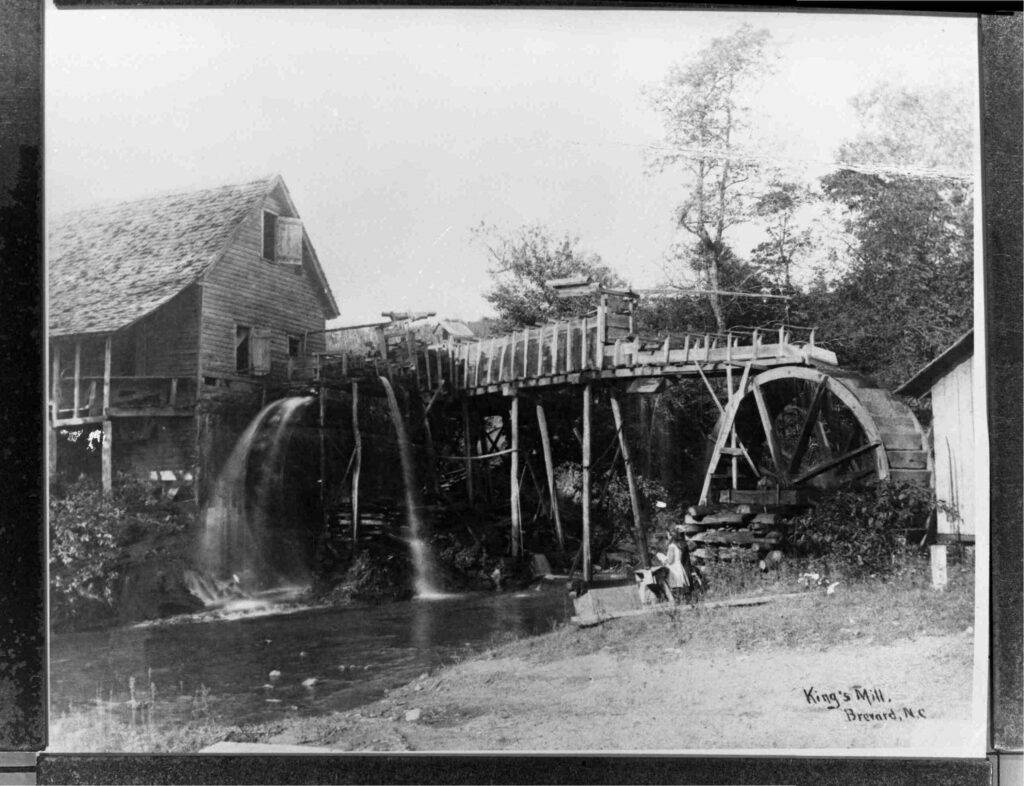
The Kings farmed much of their land and brought in income from running a grist mill, a sawmill, and a copper mine. It’s unclear if the mine was productive or simply an entrepreneurial idea that didn’t pan out. Their time in the earliest days of what would become Transylvania County has given the King name to a creek that flows through downtown Brevard and many other geographical features.
Hiram married Nancy Jane Jones in 1814 when the area was still considered Buncombe County. They had fourteen children, many of whom settled in the area and had numerous children themselves: Fannie, Elizabeth, Polly, John, Dicey, Joseph, Samuel, Leah, Benjamin, Thomas, Susan, Robert, Tilda, and Hiram Polk “H.P.” When Nancy passed away in 1856, Hiram remarried to “Polly” Mary Ann Haddon, and they had only one child, Jane.
One interesting glimpse at other people connected to Hiram King materialized from the archives. Although he was a wealthy landowner, it seems that Hiram is only recorded as owning one enslaved person named Cleariah and later her children.
Hiram King’s purchase of Cleariah is outlined briefly in Frank L. Fitzsimons’ 1976 book “From the Banks of the Oklawaha.” It describes a bill of sale dated March 25, 1832, stating that Hiram King paid $235 (equivalent to about $9000 today) for “a negro girl name of Cleariah—seven years of age which girl we warrant to be sensible and sound and a bound slave for life.”
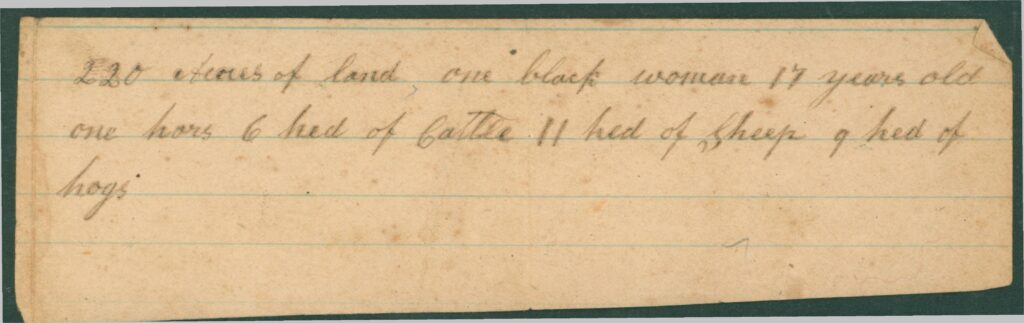
An undated slip of paper in the NC Room archives that is identified as being found in the Hiram King Family Bible seems to be a list of his most valuable assets at the time, enumerating “220 acres of land, one black woman 17 years old, one hors (sic), 6 hed (sic) of cattle, 11 hed of sheep, 9 hed of hogs” in the way one might when preparing to draft a will or some legal document. It seems likely that the 17-year-old woman is Cleariah, placing the date of the slip of paper at 1842.
Federal slave census records conducted in 1850 show that the only slaves living on the Hiram King property at that time were a 25-year-old woman and three children: a 7-year-old boy, a 4-year-old girl, and a 9-month-old girl. These records do not include names of the enslaved, only age, gender, and color; but the age of the woman aligns with the 1832 purchase date of Cleariah. This indicates that Cleariah had her first child at 18 years old and could indeed have been the one and only enslaved person on the property until she had children.
The next federal slave census was conducted in 1860, and at this time, there is only one enslaved person on the Hiram King property: a 14-year-old girl. This age aligns with the age of Cleariah’s eldest daughter, but it doesn’t explain what happened to Cleariah and her other two children. During this time, there could be any number of explanations for why the rest of the family was no longer on that property, including sale to another family, or illness and death. We may never know the exact fate of Cleariah, but it is still more information than is often left behind about the enslaved people who labored on the land.
Hiram King planned ahead for his eventual death. He set aside land for a family cemetery that grew to include many generations of Kings and the families they married into. Family legend says that he prepared ahead for his own casket as well. According to the story, he took care to craft both his wives’ and his own coffin in the most skillful manner with wood harvested from his land.
Hiram King died in 1891 at age 98 and is buried in the King’s Grove Church Cemetery, now also known as the Hiram King Cemetery, alongside both deceased wives. A row of fieldstones behind the family graves may also indicate burials for the enslaved, though no markings are etched in the stony surface to confirm that theory.
The cabin now known as the Hiram King House truly ought to be known as the Hiram Woodfin King House, because it was not built by the original Hiram King (1794-1891) but by his grandson, Hiram Woodfin King 1844-1935). Hiram Woodfin King, or Hi, had served in the Civil War and returned home to find that the family homestead was under threat. During his absence property taxes had been levied and were not able to be paid, putting the property at risk. His father, John Jones King (1821-1865), had been killed in the last couple of months of the Civil War, and his mother Rebecca Stepp King (1825-1865) had also died that year at the age of 40 leaving four children behind all under the age of 18. Hi was the eldest and a lot of responsibility was thrust upon his shoulders by these circumstances.
It took years of court battle to reclaim the property, but they finally did in 1880. Just two years later, Hi built his cabin in Pink Beds in 1882 with a variety of native hardwoods such as maple, chestnut, and poplar, with red oak shake shingles. The historic home is recognized on the National Register of Historic Places. Hi and many of his relatives owned land here and passed it down to their descendants. By the time George Vanderbilt was acquiring land in the area in the early 1900s, the Kings had been in possession of their most profitable lot for over 60 years.
Deeds and property ownership were a bit unclear in the early organizing days of western North Carolina. Handshake deals and informal land inheritance left some property owners vulnerable to Vanderbilt’s desire to acquire as much land as possible in the woodlands and mountains of western NC. Documents in the NC Room at the Transylvania County Library show that Hi had to defend his long-term ownership in a legal dispute with Vanderbilt and succeeded in retaining the family property known as “Rich Bend.”
When the Kings eventually did sell the land in Pisgah National Forest, only the cabin remained that is now known as the Hiram King House. This cabin and many others abandoned by settlers once their land was sold to Vanderbilt in the early 1900s were taken over by the at-times unruly Biltmore Forestry School students, who renamed the houses with silly and exaggerated names such as “Little Hell-Hole” and “The Palace.” Such a stark contrast to how the early settlers would have viewed their mountain paradise of self-sufficient systems and living off the land.
The Hiram King house has been used as housing and the ranger station and is now part of the historically preserved section of the Cradle of Forestry, providing an interactive example of life for early settlers. Photos and information for this column are provided by the Rowell Bosse North Carolina Room, Transylvania County Library. This article was written by Laura Sperry, Local History Librarian. Sources available upon request.