English
 Arabic
 Chinese (Simplified)
 French
 German
 Spanish
 Vietnamese
This year America celebrates 250 years since its founding, and communities across the nation are taking time to reflect on history from that era. Transylvania County is proud to highlight five North Carolina patriots for local celebration this year. This is part of a series of Patriot Profiles.
Marriage and Inheritance
Penelope Padgett Hodgson married her second husband, a Yorkshire-born merchant named James Craven (1728-1754), in 1751. He was a Clerk of Court, an assemblyman, a councilman, and the Secretary of North Carolina. He and Penelope had no children of their own. Their marriage a lasted a mere three years, being cut short by his death in 1754.
Craven must have been very well-read, because his last will and testament enumerated every single possession, which included over 250 books. This was a robust personal library by colonial standards, ranking among the largest belonging to the wealthiest and most powerful men in the state. This and everything in her late husband’s possession soon became part of Penelope’s ever-growing estate.
Politically Active
In 1756 Penelope married a third time to Thomas Barker (1713-1787), a widower and prominent lawyer in Edenton. He was of the planter class, a statesman, colonial agent, and assemblyman. Through the years he held prominent positions such as being the treasurer for the new colony’s northern district and being appointed one of only four commissioners to revise the provincial statutes.
Barker and Penelope both seemed to have been politically active and known as such among the planter class. Barker had one child, Betsy, from his previous marriage and three children with wife Penelope, but none of their children together lived past one year old.
Thomas Barker acted as the colonial agent to London shortly before the Revolutionary War. He sailed to England in 1761 in order to conduct his work as a delegate, but during his absence the conflict broke out in earnest, preventing his return for 17 years. He eventually was able to slip away to France and return to the colonies from there in September 1778.
While he was away, Penelope did not seem to have any trouble managing her prominent role in the community. She in fact is credited with organizing the first women’s political demonstration in the America when she organized what is now known as the Edenton Tea Party.
The Edenton Tea Party
On the heels of the Boston Tea Party, Penelope Barker organized her own protest for the society ladies of Edenton. Accounts vary slightly, but a common version describes a gathering of 51 women who signed a statement sent on to England pledging to support the actions of the NC Provincial Congress and boycott the purchase of English tea and cloth. They published their letter of resolve in The Virginia Gazette on November 3, 1774.
The ladies are said to have met and served herbal tea made from mulberry and raspberry leaves instead of English tea before signing. Some of the signed names that are repeated on the resolve reflect the generations of women from the same family with the same name all joined in the cause.
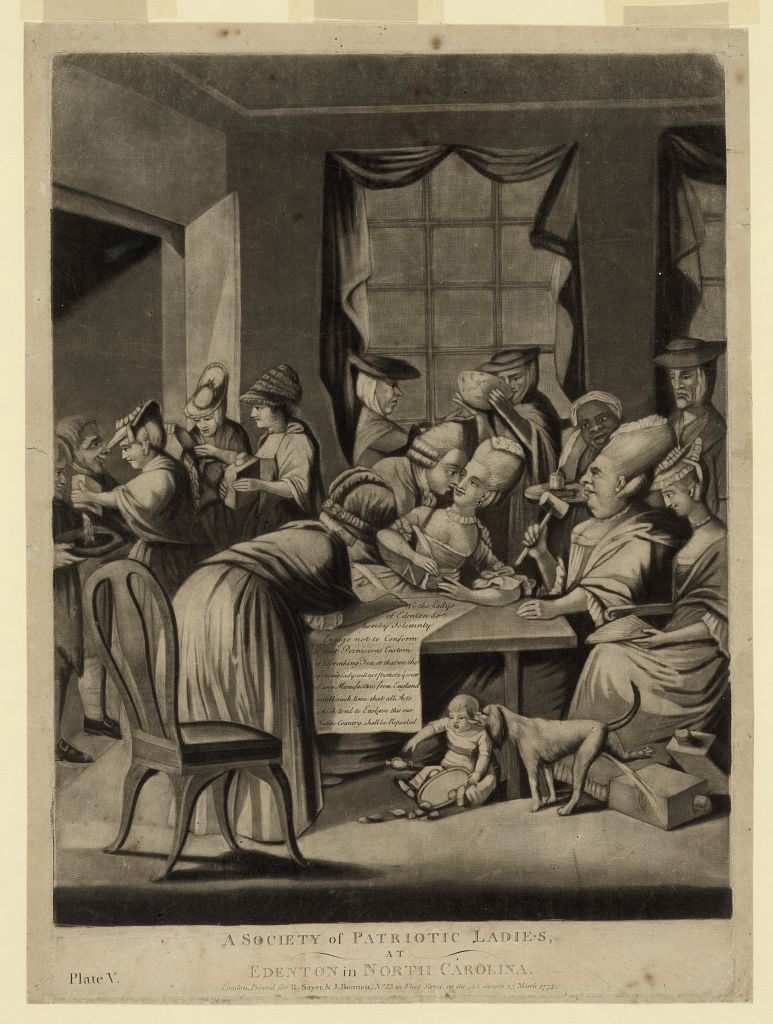
The event might have gone largely unnoticed but for a London newspaper, The Morning Chronicle and London Advertiser, which on January 16, 1775 ran a political cartoon created by Philip Dawe lampooning the Edenton Tea Party. His negative characterization included depicting the women as unattractive, uncouth, neglecting their household and child-rearing duties, and engaging in lascivious behavior.
This visual commentary is meant to characterize the women in the cartoon as frivolous, inattentive, and lacking in any social manners. The cartoonist made a decision to include a black slave in the image, to point out the hypocrisy of the agrarian, slavery-dependent colony complaining about the enslavement they felt under unfair taxation.
The Edenton Tea Party Resolve adjusted for modern spelling states: “We the ladies of Edenton, do hereby solemnly engage not to conform to the pernicious custom of drinking tea, or that we, the aforesaid ladies, will not promote the wear of any manufacture from England, until such time that all acts which tend to enslave this our Native Country shall be repealed.”
The act may seem small when viewed through modern eyes, but at the time these ladies took a great social and political risk to openly speak their opposition to British rule. It would have been considered quite inappropriate for ladies to act in this forward and outspoken manner during this very proper era in history.
The Aftermath of Revolution
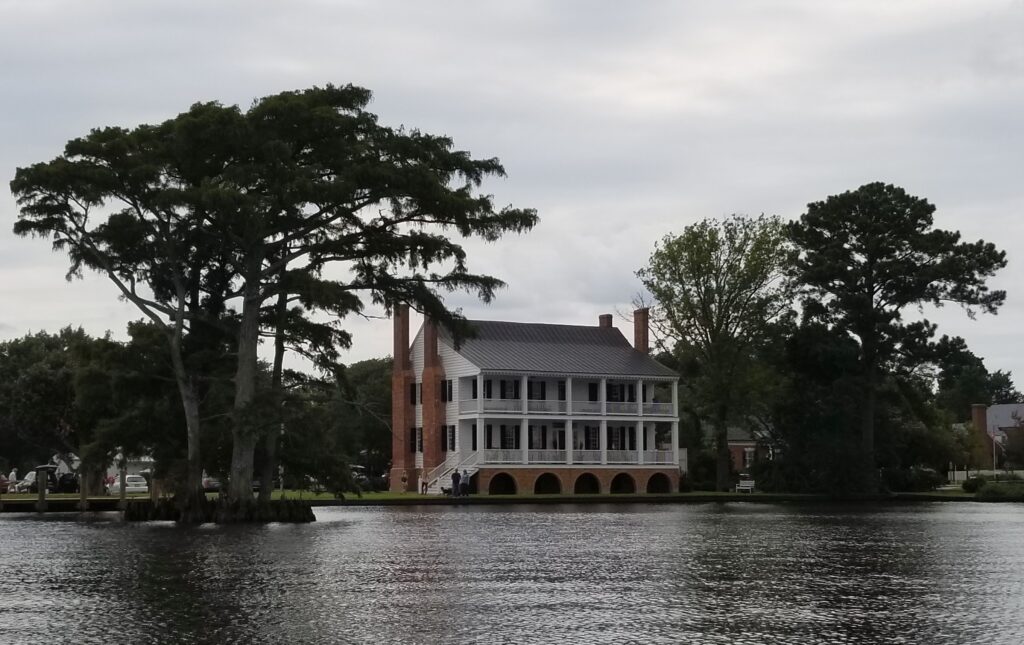
After Thomas Barker returned to his home in Edenton NC in 1778, he and Penelope built a home together which is still standing today. The Barker House was built in 1782 and had several additions and renovations through the years. Thomas died in 1789, and Penelope inherited all of his wealth and estate, living out her remaining years on the property which indeed was the very same Pagett Plantation land where she had lived as a child.
The only one of the children connected to Penelope who was still living at this time was her stepdaughter, Betsy Barker, who went on to marry the prominent William Tunstall.
Penelope Barker is recorded as having died in 1796; she died without a will, leaving the estate to be sold to the highest bidder. This occurred in 1794, according to court documents, which brings into question whether her death year was 1794 or 1796, as stated in most sources.
Penelope Padgett Barker was buried next to husband Thomas Barker at the Johnston Cemetery on the site of what is now the Hayes Plantation, which was where the very first church and accompanying cemetery in Edenton were built in 1702.
The Barker House was originally built two blocks north of its present location and was rolled to its present site in 1952, when it was also rotated to face the coastal sound and its view. It is currently the home of the Edenton Historical Society and is open to the public for tours.
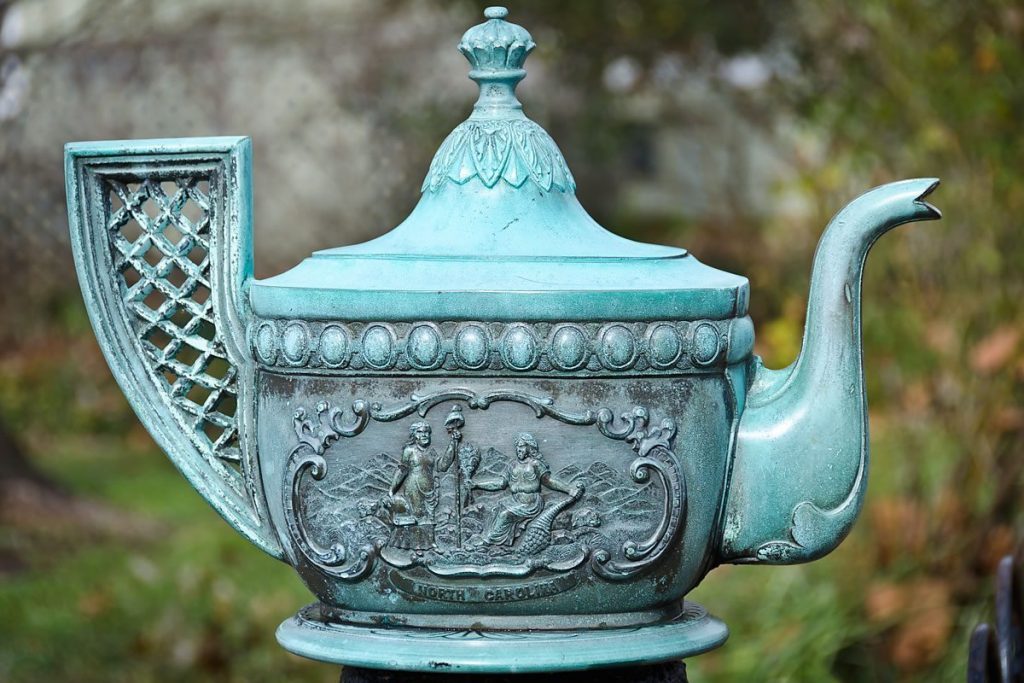
A Chowan County chapter of the Daughters of the Revolution is named after the Edenton Tea Party, and a commemorative monument stands outside the Chowan County courthouse: a copper teapot on top of a cannon symbolizing how a simple cup of tea can be revolutionary.
Photos and information for this column are provided by the Rowell Bosse North Carolina Room, Transylvania County Library. This article was written by Laura Sperry, Local History Librarian. Sources available upon request.