English
 Arabic
 Chinese (Simplified)
 French
 German
 Spanish
 Vietnamese
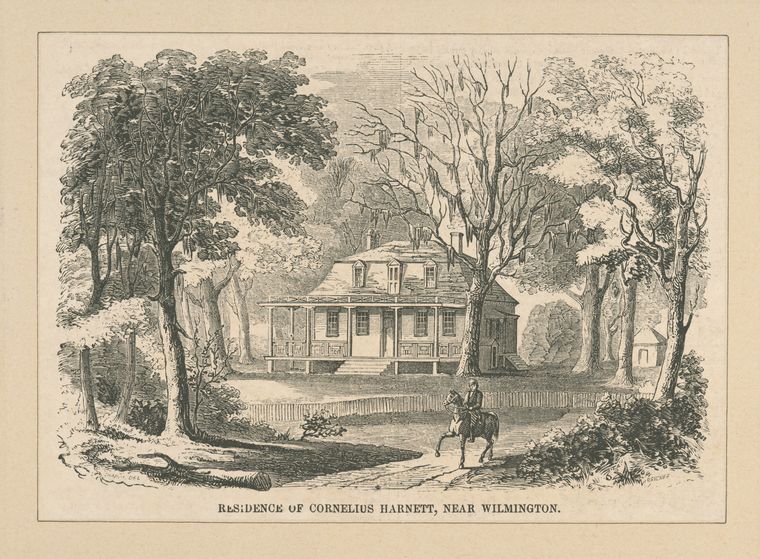
This year America celebrates 250 years since its founding, and communities across the nation are taking time to reflect on history from that era. Transylvania County is proud to highlight five North Carolina patriots for local celebration this year. This is part of a series of Patriot Profiles.
One patriot who exemplifies the inheritance of an independent spirit is Cornelius Harnett Jr. (1723-1781). The only child of Irish-born parents Cornelius and Elizabeth Harnett in Edenton, NC, Cornelius Jr. and family moved to Brunswick Town when he was a toddler to escape political turmoil in which the senior Cornelius always seemed to be embroiled.
Inherited Independence
The Harnetts bought land on the Cape Fear River, and Cornelius grew into a fine statesman serving mostly in Wilmington, NC. He was a merchant with interests in farming and milling. His business ventures included being a partner in a distillery operation with a still house, wharf, warehouse, and schooner. One source claimed that he was “a genius in music and a writer of force and elegance.”
Cornelius was elected as a representative for New Hanover County and the town of Wilmington in 1750 and served in a variety of public offices for many years up until his death. Some of the titles and positions he held included General Assemblyman, Justice of the Peace, and Chairman for the Wilmington chapter of the Sons of Liberty.
In 1765 England passed the Stamp Act, attempting to levy taxes on the American colonies. At the time of this legal action, North Carolina had no representatives in the Congress, which instigated a loud outcry of dissent from Carolinians. In Brunswick, where Harnett was living at the time, armed Sons of Liberty led by Hugh Waddell, John Ashe, and Cornelius Harnett Jr. sabotaged British troops and their attempts to enforce the taxation.
The Samuel Adams of North Carolina
Cornelius’ involvement in the revolutionary cause prompted Massachusetts Revolutionary leader Josiah Quincy to dub Harnett as “The Samuel Adams of North Carolina” in 1773 after visiting him to strategize about their efforts. Many revolutionary moments happened in the following years, and Harnett was often at the center.
The Sons of Liberty were so adept at intimidation and revolution that in May 1775 Tryon Palace, the Governor’s mansion which was modeled after Buckingham Palace, was seized by colonists. The Governor, Josiah Martin, fled to the seas to reside and operate from the safety of a ship in the royal fleet, H.M.S. Cruizer, which became an ersatz floating office of the state. As the unrest leading up to the American Revolution escalated, Governor Martin attempted several times to return to office on land only to be driven back to the harbor and safety of the British Royal Fleet to govern.
One noteworthy revolutionary occasion came to pass on July 19, 1775 when a group of colonists led by Harnett and partners John Ashe and Robert Howe burned Fort Johnston at the mouth of the Cape Fear River. Governor Martin was unable to stop the revolutionaries from seizing the fort and burning it to the ground, which was seen as the first act of revolution in NC.
Councils of Safety
In response to the lack of safety that many colonists felt under British rule, many communities organized “Councils of Safety” to keep law and order. Harnett served on many of these – in fact, some sources indicate that he served on more committees concerned with devising measures to defend the state than any other man in the country at the time. The appointed groups ensured debts were paid, crimes were punished, and laws obeyed. They enrolled men into companies for defense and distributed supplies. They were organizational leaders whom the nascent colonies relied upon to make their settlements function in an orderly manner.
Harnett was elected as the President of one of the first Provincial Councils, making him a political figure and potential target for dissent. During this tumultuous time in American history, leadership groups formed and dissolved, groups of colonists banded together and wrote resolve after resolve to speak out against unfair British rule, and Cornelius Harnett Jr. is said to have been involved in drafting many of them, including the Halifax Resolves and the Mecklenburg Resolves.
The story of Cornelius Harnett Jr. will continue with Part Two. Photos and information for this column are provided by the Rowell Bosse North Carolina Room, Transylvania County Library. This article was written by Laura Sperry, Local History Librarian. Sources available upon request.