English
 Arabic
 Chinese (Simplified)
 French
 German
 Spanish
 Vietnamese
This year America celebrates 250 years since its founding, and communities across the nation are taking time to reflect on history from that era. Transylvania County is proud to highlight five North Carolina patriots for local celebration this year. This is part of a series of Patriot Profiles.
Benjamin Davidson (1743-1825) was baptized on May 8, 1743 in Augusta, Virginia at Tinkling Springs Presbyterian Church. Different genealogical sources associate him with different parents, but a commonly accepted lineage shows his parents as Samuel Davidson (1705-1765) of Dublin, Ireland and Margaret Sarah Maner (1703-1797) of Orange, Virginia. The Davidson ancestry is notoriously difficult to trace, as there was a group of cousins and extended family that migrated to America from the British Isles, settled in the same locales, and named their children similar names from the popular family tradition.
Family Ties
It’s unclear how many of his siblings were full and how many were half-siblings, but Ben Davidson’s immediate family seems to have consisted of brothers James Moses, George, John Gillis, James, Jesse, and William, and sister Nancy in addition to his parents.
Sources agree that Ben married Elizabeth “Ann” Patton (1748-1833) in 1772 when he was 28 years old, and that he had ten children: Rhodia, Mary “Polly”, Isabel, Elizabeth, Anne, Benjamin Jr., James, Rebecca, Sarah, Erixina “Rixey”, Sophia, and Martha.
Although there is no documentation, it seems likely that Benjamin had a first wife who died before he married Ann in 1772. Rhodia and Polly were born in 1760-1765, and it seems unlikely that these children would have been born out of wedlock during this era and to this class of people. Also, Ann would have only been 12 years old when Rhodia was born, so it seems likely that Ann was a 2nd wife and perhaps mother to only the later-born children in the family.
Patriotic Service
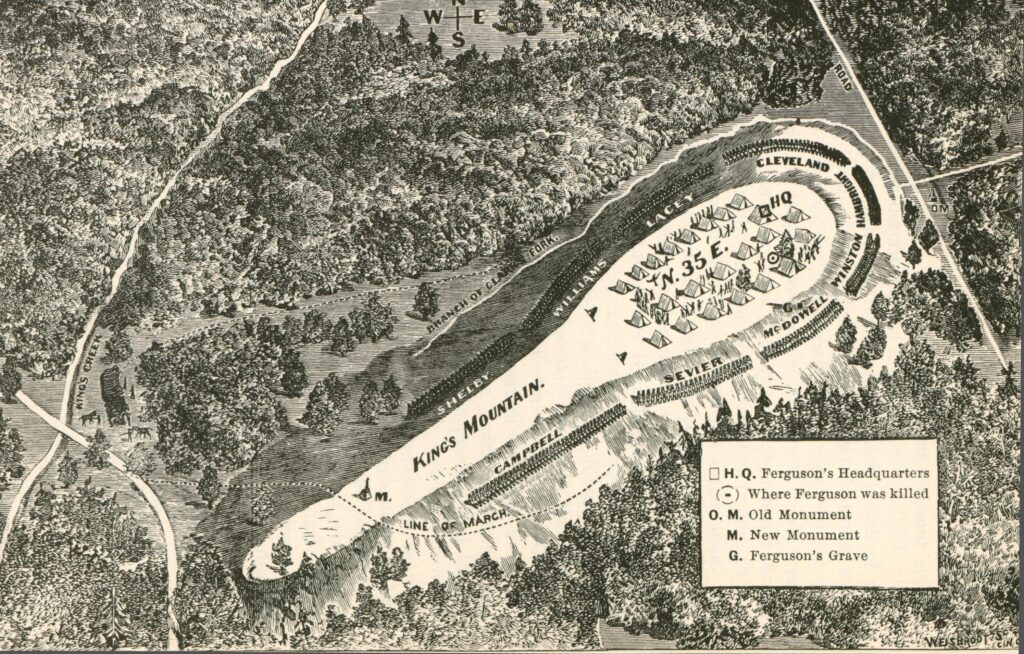
The Davidsons had settled in the Catawba River Valley and many of them, including Benjamin, served in the Revolutionary War. Benjamin is recorded as serving with distinction at the Battle of King’s Mountain under the command of Major Joseph McDowell.
The Battle of Kings Mountain was a pivotal victory for the American patriots and one of the most significant to occur in this region. Just over the state line in what is now York County, SC, the battle was fought with guerilla warfare tactics and saw a vastly outnumbered rebel force triumph over the British military.
Units under the command of several Patriot leaders from several states joined forces to surround and outnumber the British, with final casualty totals estimating 150 killed, 163 wounded, and over 700 captured when all was said and done, compared to a mere 28 killed and 63 wounded of the American colonists. This battle and the battle of Guildford Courthouse a few months later proved to the British that they couldn’t win against the Colonists in this terrain, prompting them to withdraw British troops from North Carolina altogether.
Bounty Land Grants
To incentivize enlistment and compensate for low wages, the state granted land or the right to purchase land to soldiers of the Revolutionary War. There was a standard rate of pay per month that the enlisted served, and so if the enlisted were involved in the entire war (84 months), records will show very regular acreage amounts that they were approved to purchase from the state. A private received compensation at the rate of 7.6 acres per month, and so many of the so-called bounty land grants for this region reflect an entry-level ranking of private being awarded the right to buy 640 acres, whilst an officer such as a brigadier general might earn as much as 7,200. Grants could be sold to a willing buyer and those they were awarded to did not ever have to reside on the land before selling it at profit to the more adventurous who wished to settle the land.
Those who served in the Revolutionary War earned the right to buy land in western North Carolina. Although it’s commonly thought that the early settlers received land grants for what is now Transylvania County, it is more precise to say that they earned the right to land application but still had to purchase the lands they eventually owned. Many Davidsons went to the Swannanoa section of what is now Buncombe County before a subset settled in what is now Transylvania County.
Land Across the Woods
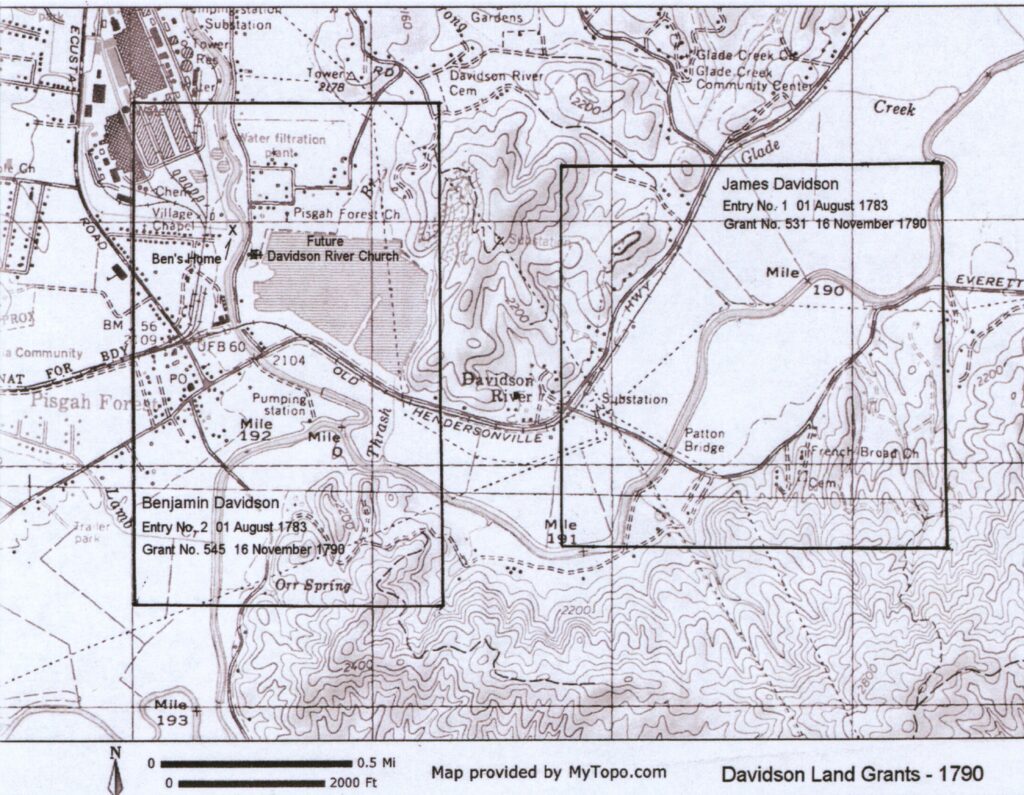
The first two European landowners in our county were James and Benjamin Davidson. The relationship between these two men has been debated, but it’s thought they were half-brothers or cousins. James was issued land grant number one, and Benjamin land grant number two for 640 acres at the head of the French Broad River. Benjamin and his growing family were living in the Morgan district of Burke County at the time but moved in 1794 to settle on the land he’d acquired in Transylvania County in a process that began nearly a decade before.
Benjamin Davidson was a surveyor who worked for the federal government. According to Ben Ormand, compiler of the history of the Brevard-Davidson River Presbyterian Church, Ben was laying out land boundaries as part of his employment when he also set aside land grants number one and two in Transylvania County for himself and his neighbor and relative James. Ben’s property contained the headwaters of a branch of the French Broad River.
More in the next article on Davidson’s civic contributions and charitable acts. Photos and information for this column are provided by the Rowell Bosse North Carolina Room, Transylvania County Library. This article was written by Laura Sperry, Local History Librarian. Sources available upon request.