English
 Arabic
 Chinese (Simplified)
 French
 German
 Spanish
 Vietnamese
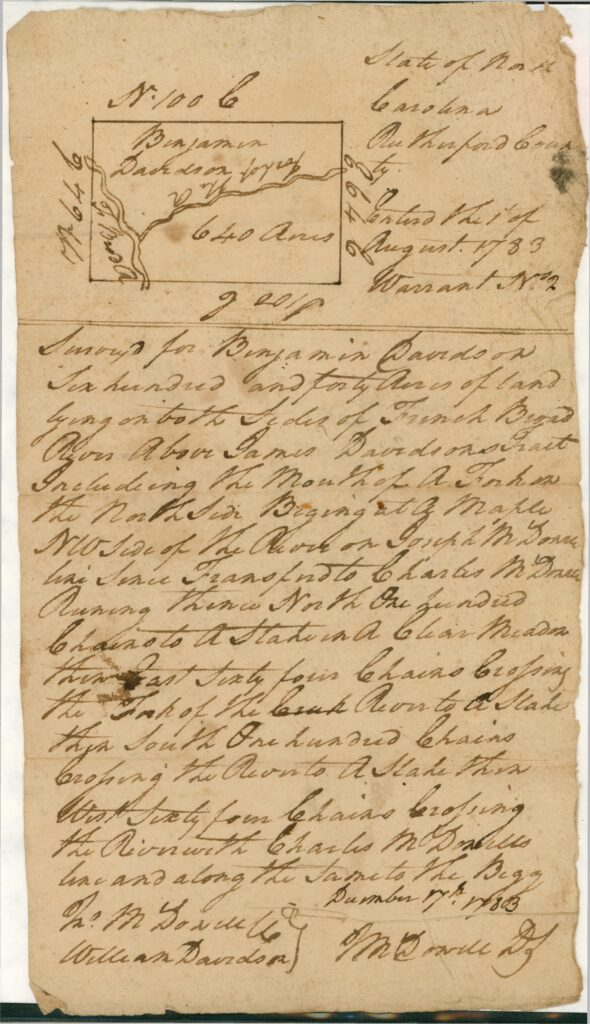
This year America celebrates 250 years since its founding, and communities across the nation are taking time to reflect on history from that era. Transylvania County is proud to highlight five North Carolina patriots for local celebration this year. This is part of a series of Patriot Profiles. The story of early settler Benjamin Davidson continues.
Boilston Road
“Ben Davidson’s Creek” was a noted geographical feature, and over time the name changed to the Davidson River. The land that belonged to Benjamin Davidson was very near but did not include the breweries of Ecusta and Oskar Blues. The location of Ben’s plot of land was a central transportation hub, and a thriving business grew from it.
Like many large early homes, Col. William Davidson’s property in Swannanoa and Ben Davidson’s property at the headwaters of what was at that time named Davidson’s Creek were waypoints on a path between centers of community and commerce. It was determined that the same military companies and leaders would be mobilized for road construction that had previously served in the War.
The two relatives’ residences were identified as the end points of a travel route that was federally ordered to be constructed to allow for the increasing traffic between those areas. That route, Boilston Road, is what became Highway 280, also known as the Boyleston Highway or Asheville Highway.
It followed a common route that was very near Forge Mountain and the Gillespie Iron Works there, and that crossed the French Broad River at an area known as “Long Shoals”, which still remains as Long Shoals Road, which was the safest place to ford the river in a time before bridges had been built.
Legacy of Faith
Benjamin’s ten children married into prominent families of the area, and soon he was an early establisher of the first church house in the area, according to popular lore. His eldest daughter Rhodia married Reverend Samuel Davis, who was the minister of the Davidson River Church, which was built on Benjamin’s land. Ben and his family settled there in 1790, and so it seems logical that sometime in the decade thereafter, they established a way to worship. Ben had been a member of the Swannonoa congregation and brought his connections to traveling ministers and the larger church with him.
The foundation of the Davidson River Church began as early as 1800 with a congregation which began to meet long before they had a common building in which to do so under the leadership of Rev. Davis. Documentation shows that in December 16, 1826 Benjmain Davidson deeded a portion of his property to a group of five trustees, Mackey, Clayton, Neill, Davis, and Orr, in order to build a “free meeting house” for the use of the community.
This original meeting house was not technically a church, since it was not associated with one particular congregation or faith. Davidson determined that there should be a rotation of different faiths able to use the building, with one Sunday per month being set aside for the Presbyterians, Methodists, and Baptists, and the fourth or fifth week being set aside for any traveling preachers or circuit-riders. Because of the community-wide involvement at the original Davidson River Church, for many years after the smaller church joined with the Brevard Presbyterians to form one congregation the original site would host “Davidson River Day”, a sort of camp-meeting potluck very similar to the traditional Homecoming celebrations that many southern congregants enjoy today.
The church went through a reorganization at this time too, solidifying its membership and strengthening their organizational structure in 1828 under the Rev. H.M. Kerr. By this time the Rev. Davis had moved with his wife Rhodia to live in South Carolina with his adult daughter and her family. The 1828 membership included 28 members.
Church Building Transformation
There seems to have first been a smaller more rustic church building before a larger, two-story building was erected in 1855. The new building had rooms for school classes to use during the day and held the worship space with pews and pulpit on the upper story. A church “manse” was built in 1891 on land donated by Mary Jane Glazener to house any clergy commissioned to serve the congregation. The manse was never lived in and was sold in 1934. Several building renovations later, the chimney stones of the original but deteriorating Benjamin Davidson house were utilized as the stone steps for the church building in 1923.
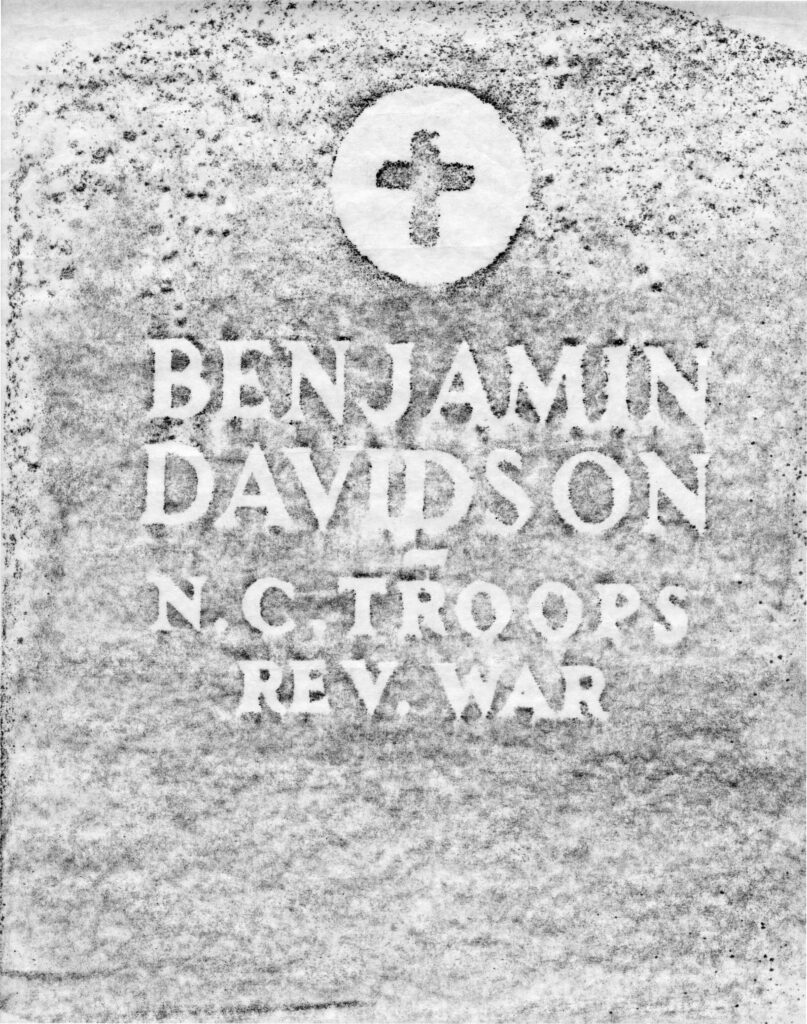
Benjamin died in 1825 and was buried in the Davidson River Cemetery. Some of Transylvania County’s oldest burial sites are located in this cemetery and the Daughters of the American Revolution have marked Revolutionary War veterans’ graves with distinctive plaques to commemorate their service.
In the later part of his life, Benjamin deeded his estate to his daughter Rixey under the condition that she caretake her elderly mother. A court case concerning her inheritance is some of the only documentation that exists to name Benjamin Davidson’s children. Rixey was the sole inheritor, and her only child was her only inheritor. When that child died unexpectedly early in the 1850s, the courts were tasked with finding the true heirs. This provided much of the information later researchers have utilized about Benjamin Davidson’s family.
The legacy of Benjamin Davidson and his family can still be seen today in Transylvania County in the naming of the River and the Church that still bear his surname.
Photos and information for this column are provided by the Rowell Bosse North Carolina Room, Transylvania County Library. This article was written by Laura Sperry, Local History Librarian. Sources available upon request.