English
 Arabic
 Chinese (Simplified)
 French
 German
 Spanish
 Vietnamese
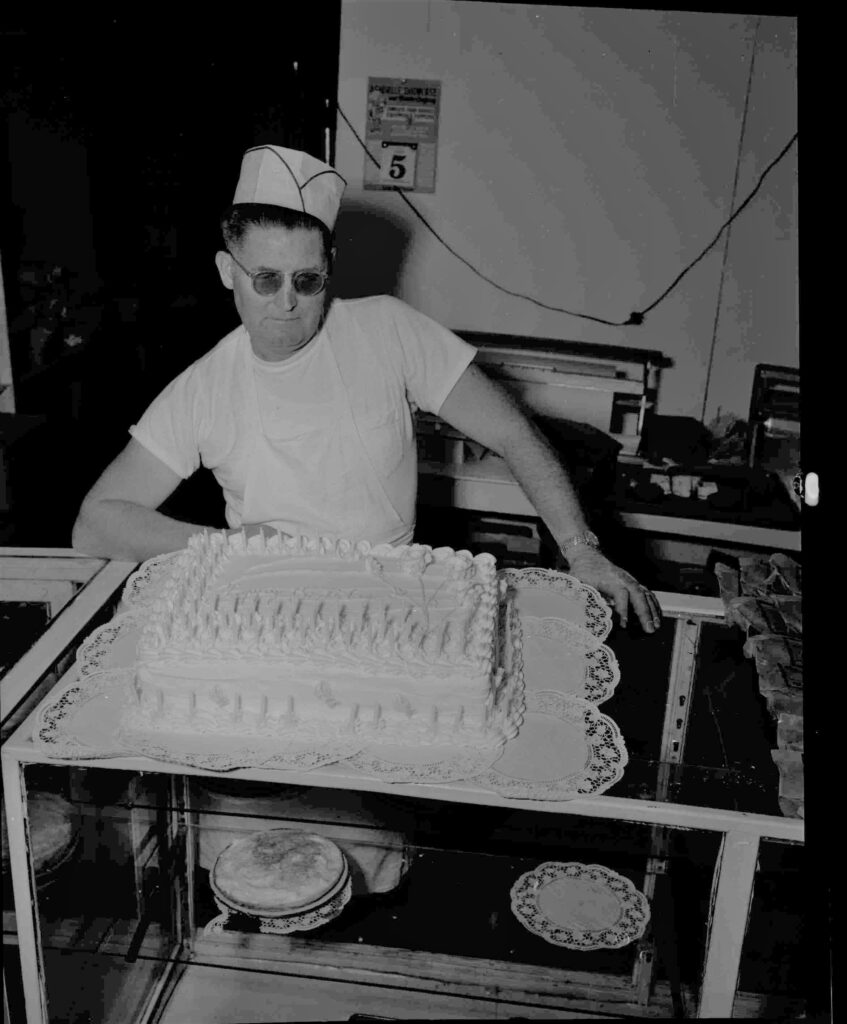
Bakeries continue to delight our hearts and bellies through sharing food for comfort, celebration, and community. Although home bakers abound and many retailers and coffee shops have baked goods, for this series bakeries will be defined as a business whose primary purpose is to bake breads, celebration cakes, and pastries.
In the 1940s there were ads for a different type of bakery that began to pop up in local newspapers. Becker’s in Hendersonville continued to advertise, but by 1945, Bost’s Bakery in Shelby was running ads to promote their industrial baking facility. This and many other facilities around the U.S. promoted a “scientific way” to bake bread that was touted as superior to home baking or quaint local operations.
Scientific bread-making boasted convenience (pre-slicing), fortification (vitamins added to flour to enrich it), and chemical additives to maintain shelf life and texture regardless of how fresh the bread is. These new chemicals shortened the time needed for leavening and were often in a base filler of soy flour, adding another component to bread mixes. None of these innovations were possible for home bakers, setting apart bread made with new technologies.
The mentality that technology improves bread was also influential to the type of bread that was commonly used. “Enriched” flour and uniform white bread came to be known as hallmarks of superior products. It’s possible that World War II production led the way for this type of baking to become more common. After its conclusion, the same facilities that were producing food for the troops could be repurposed to feed the masses.

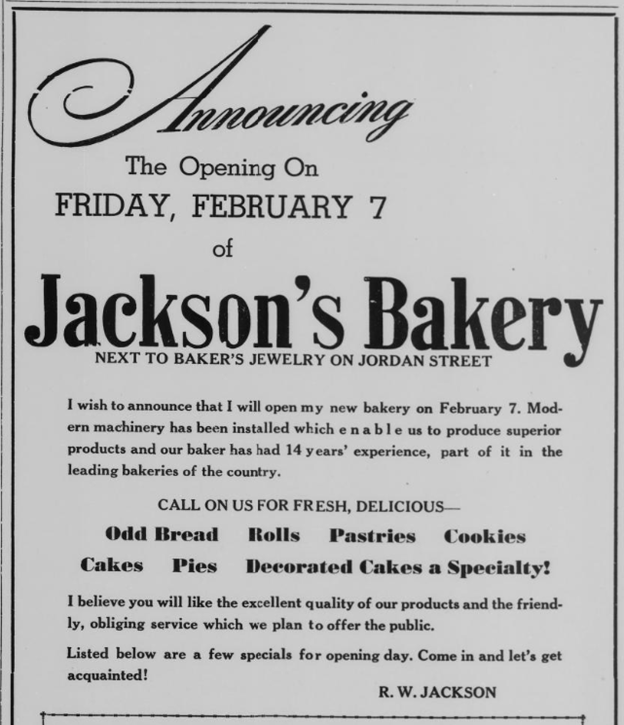
In 1946 Jackson’s Bakery opened on Jordan Street and was run by Bob and Kathryn Jackson of Asheville. Kathryn had been an Orr prior to marriage and was from Transylvania County, so was returning to her hometown. By 1948 the Jacksons renamed the bakery Quality Bakery and became a franchise-style affiliate of the much larger Quality Bakeries chain based out of Asheville, which was an industrial facility aligned with the new system of baking.
Very shortly after this change in 1948, the Jacksons sold their business to Sonny Owenby of Hendersonville. An ad in the April 28, 1949 Transylvania Times announced an open house to celebrate yet another renaming of the business as Sonny’s Bakery, with Owenby at the helm.
The name of the Bakery changed yet again to King Bakery in 1950, though the proprietor is not mentioned. It doesn’t seem to have lasted for long, because by June 1951 a different unrelated business moved into “the former location of King Bakery.”
A few months later in May 1950 Krispy Glaze Bakery (1950-1973) ran their first ad. The Krispy Glaze Bakery was owned and operated by A. B. “Red” Barger and wife Juanita Barger. They sold donuts, cakes, and pastries.
At this time, the supermarket concept was really taking hold in the U.S. Prior to this, people would visit their neighborhood grocer for their food needs. It was considered an innovation to move to a larger, more industrialized model that involved large chains of retailers setting up businesses in a larger footprint area.
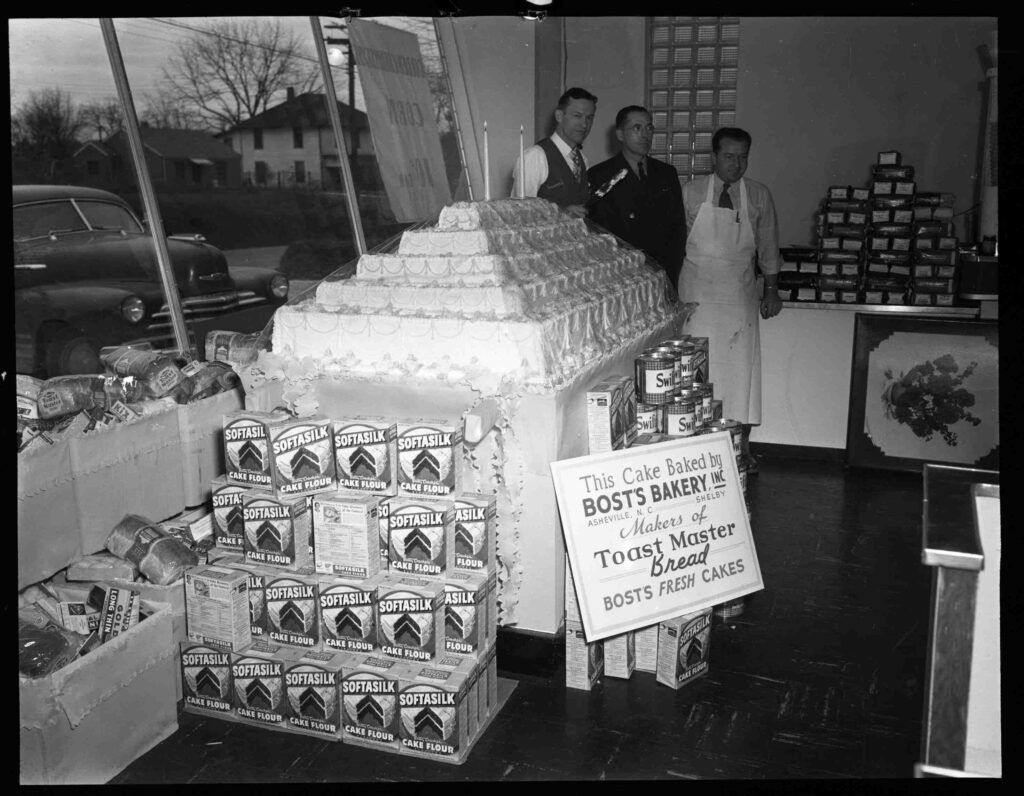
A type of rivalry seems to have resulted where large grocery retailers tried to convince consumers to abandon the small-scale local baker for an industrialized product from further away. One such event that occurred in Brevard was the Harold’s Supermarket 2nd birthday celebration.
Harold’s owner Harold Saltz worked with corporate sponsors General Mills and Bost’s Bakery in Shelby, NC to bring in a 533-pound cake. It was at the time the largest every baked in western North Carolina and was brought in via station wagon. The supermarket’s front pane of glass had to be removed in order to bring the cake inside, as the door was much too small to fit the three-tiered cake decorated with 235 yellow and pink roses.
If their aim was to put Krispy Glaze out of business, it did not work. Krispy Glaze continued to be the go-to bakery for many years to come, only shutting down in 1970 shortly before the supermarket trend expanded even more with the construction of a Bi-Lo grocery store, complete with a full bakery department.
This concludes the overview of bakeries in Transylvania County from the 1940s-1960s. The next article in the series will continue to describe Transylvania bakeries in the 1970s to today.
Photos and information for this column are provided by the Rowell Bosse North Carolina Room, Transylvania County Library. This article was written by Laura Sperry, Local History Librarian. Sources available upon request.