English
 Arabic
 Chinese (Simplified)
 French
 German
 Spanish
 Vietnamese

Those who enjoy history are familiar with the preponderance of people in our region who have ancestry from the Scotch-/Scots- Irish. The Scots-Irish were not all necessarily of Scottish heritage. The northern part of the British Isles, where Ulster lies, was at times a dumping ground by those in power for the “inconvenient and troublesome” people who stood in the way of their plans. Those residing in these areas were from a variety of backgrounds, including Irish, north English, and Scottish; the term Scotch- or Scots-Irish for that reason can be a bit misleading and has more recently been updated to the more precise term Ulster Scots by historians.
The people of this area were on the border of England and Scotland, and the nature of the land and political attitudes toward the residents there shaped a culture where the “Borderlanders” may have had more in common with each other than the separate cultural groups from which they originated.
other than the separate cultural groups from which they originated.
One defining characteristic of the group was religion. During times of religious conflict, Protestants were at one time the minority in Scotland and Ireland, and so many of these Ulster Scots were Protestant, having been inconvenient to the Catholic majority. Later Irish immigrants to the US would mostly be Catholic, and so it is important to distinguish these groups from one another.
This region was relentless in its weather, less fertile for farming, and constantly contested via small warfare as to which lord controlled it. The Borderlanders lived an existence that was harsh and unforgiving, which often required quick mobility, adaptability, and resilience. In this violence-driven world, it was not always wise to rely on outside government to follow through with promises or to have the best interests of the people in mind.
The men had a reputation as warriors who were not always keen to settle down and farm, instead preferring a brave life of conquest and acquisition. Strength, physical demonstrations of power, and cunning were encouraged to grow young men into proud individuals, disinclined to obey orders or accept outside assistance beyond the family. This was a direct result of the fractured power structure of North Britain where the landlord would sometimes accept military service from his tenants instead of rent, and in which those small militias were crucial to the retention of that lord’s wealth and power. Men could earn honor and prestige through this service and had few opportunities otherwise.
A code of conduct was developed that allowed for some types of activities considered illegal in other communities, but which were permissible under the correct circumstances. In this Border Law, one could raid cattle of neighbors but not commit highway robbery. If cattle were stolen, the offended party had the right — and near compulsion — to retrieve them within one week with whatever force deemed necessary, as long as it was done openly according to tradition.
Family ties were considered a major building block for survival. Family extended beyond just the nuclear bubble and included four generations of any extended members within. Marriage was taken very seriously as it meant introducing a new member to the family unit who would be treated with as much protection and inclusion as blood members. We recognize these family groupings as clans, but they also went by the term “derbfine.”
Inheritance could be spread among this more extended family, and naming practices show that relationships with aunts, uncles, and cousins, known as collateral bonds, could be given just as much importance as those with one’s own children and siblings, or direct lineal bonds. Cousins might even have the same given name and be distinguished by nicknames.
Families accrued wealth and power, and this is what gave them social status. Honor, both personal and familial, was of utmost importance and could lead to death if threatened or degraded. Social expectations were also taken very seriously and if not followed would lead to social ostracism and harassment.
Social standing was less about a collection of possessions and more about wealth, power, and kinship ties which gave strength and clout. If a family ever lost their wealth, they immediately also lost their social status.

The border itself was often disputed, and this led to an instability that is evident in how land, wealth, and homes were approached. Many of these Borderlanders didn’t own the land they lived and worked upon. An unjust system that allowed landlords to dominate and extort resources from their tenants led many Borderlanders to disinvest in permanent structures and land improvements that they likely would not personally benefit from.
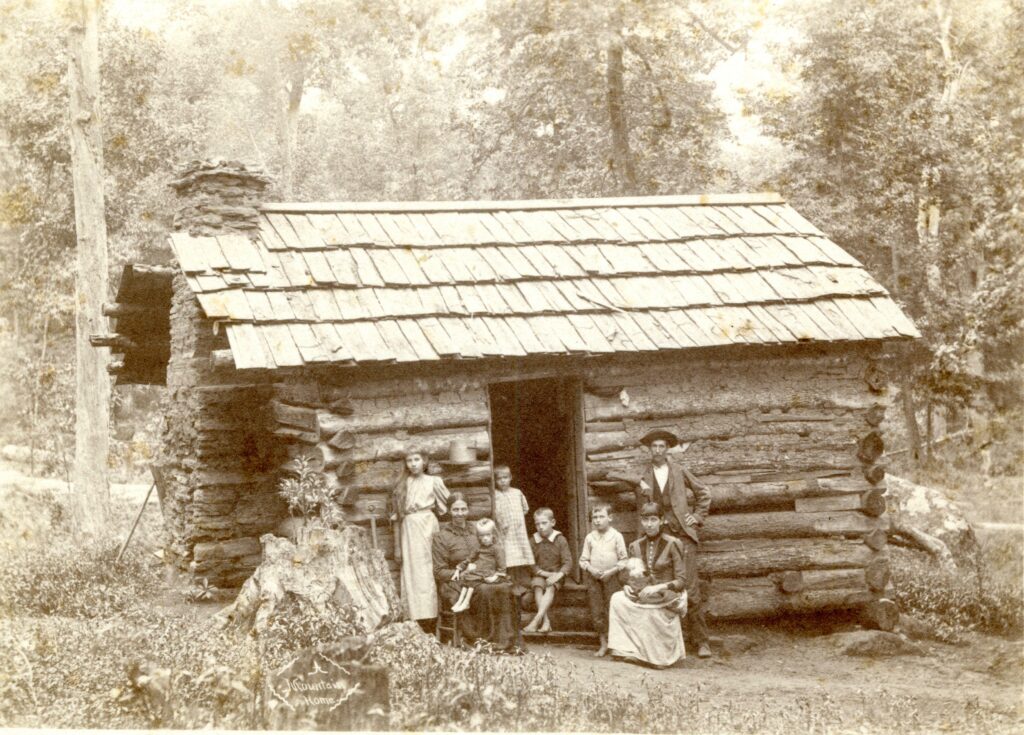
The quintessential log cabin that is associated with Appalachia was a building style that came directly from these Borderlanders, who in Europe may have had to move quickly due to rack-rents or the destruction of their homes during the many conflicts over borderland control between the parties in power.
Culture was passed through song and less through formal education. They were as a group highly literate, but didn’t necessarily value higher education, as it was often centered around an outside culture and their values, such as the English aristocracy.
The influence of these cultural attitudes and customs can be seen in the rugged mountain people of Southern Appalachia, who in modern times have been vilified as insular and backwoods due to their isolated and fringe existence. Rather than springing from inherent character traits, it seems that the very nature of the land and ruling class created the circumstances that shaped these early British emigrants. They found not only a similar climate and topography in the Blue Ridge mountains, but also a social structure very similar to what they had fled, which is why their ways remained largely unchanged, even in the New World.
Pride, family loyalty, fierce independence, distrust of large government and its institutions, and a tradition-based culture of generational continuity continue to be hallmarks of this incredibly large and influential cultural group that has defined the Blue Ridge and other areas of the southern highlands.
Photographs and information for this column are provided by the Rowell Bosse North Carolina Room, Transylvania County Library. This article was written by Local History Librarian Laura Sperry. Sources available upon request.